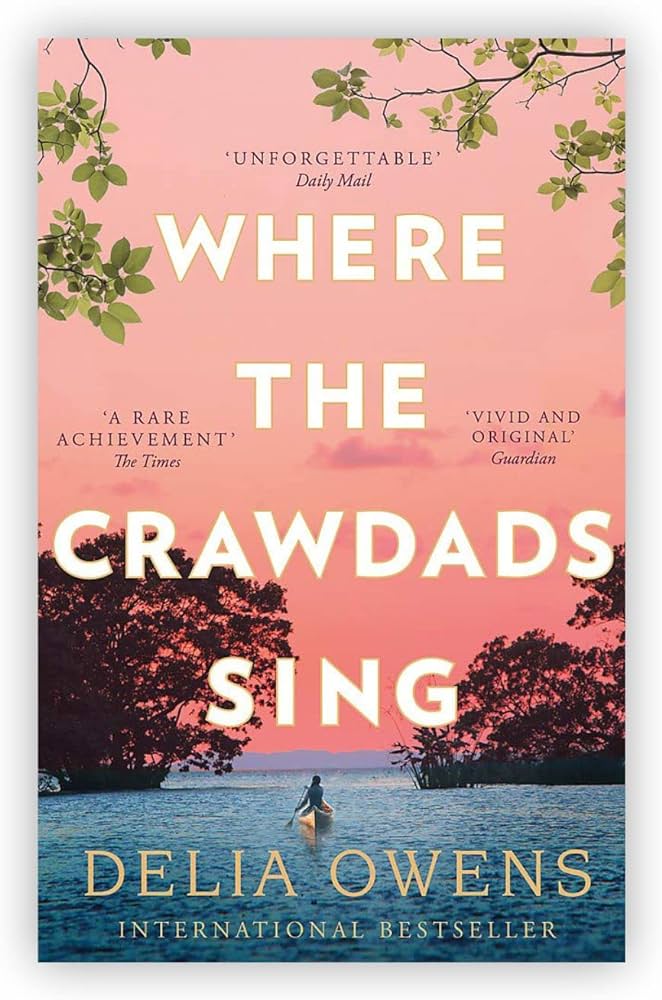
“Just like their whiskey, the marsh dwellers bootlegged their own laws”
Author: Delia Owens
Chase Andrews fell from the old fire tower… or was he pushed? As the sheriff investigates the strange death, he discovers a connection between the local girl “Marsh Girl” and Chase. No one knows the marsh better than Kya, the “Marsh Girl,” but does she know it well enough to kill a man without leaving a trace? Will Kya be locked up for murder? or will she stay in the marsh she loves, free and wild, where the crawdads sing?
Kya is a very nice change of pace from the super competent female protagonist of many novels you get these days. Kya is a character living with trauma. She both craves and fears human connection. She wants to love and be loved, but her life experience has taught her that other people will only hurt and abandon her.
Kya’s was abused/neglected/ abandoned by her whole family. Pa was abusive, Ma walked out, and her older siblings ran away from home. While Pa was good to Kya sometimes, he never cared enough to take her to school, buy her shoes, or teach her to read. Then one day, he went out drinking and never came home.
Kya is a lot like a wild animal, acting on instinct and withdrawing in fear. It’s exactly what a child who raised themselves would be like.
The murder mystery was the weakest part for me. I knew the truth of how Chase died VERY early on in the story. I don’t think the murder mystery was intended to be the point. It’s Kya’s story, and the mystery was a narrative device to drive the plot forward.
There is a reason this book was so popular and it was quickly turned into a movie. Owens knocked it out of the park with her first novel! It is well worth the read.
“None of the things one frets about ever happen. Something one’s never thought of does.”
Author: Connie Willis
In a world with time travel, it would be only natural for it to be used to study history.
When a young historian is sent into the Middle Ages, she thinks she was prepared for anything. The medical staff treating her made sure she was inoculated against all of the nasty plagues sweeping through England, but there is no inoculation for her heart. It’s one thing to read about abusive historical customs like child brides, it’s quite another thing to see the fear in the face of a little girl you have gotten to know as she meets her “intended” for the first time.
The head historian fears sending someone to the 14th century due to the Black Death, but it’s back home at the college where a pandemic breaks out.
Reading this book post 2020, was kind of chilling. Lockdowns, people ignoring the damage done to children, the rules not applying to certain people, I found myself double checking the copyright more than once. I assure you, it was originally published in 1993, and re-released in 2023. My copy was the re-released version so I don’t know if any details where updated after the 2020 pandemic, but the plot itself couldn’t have been.
This is a very good, very sad book. I’ll tell you right now, this a story about a plague. A lot of characters die. It’s not a beach read.
I do recommend this book, but I recommend you do some soul-searching and make sure you don’t have any COVID-19-related trauma before you read this book. I didn’t think I was traumatized by COVID-19 until the plague hit the college in this book prompting lockdowns that I found myself having to take a break. I didn’t realize that I had lingering trust issues around how public institutions handle public safety until I found myself upset at how the college handled the pandemic in this book.
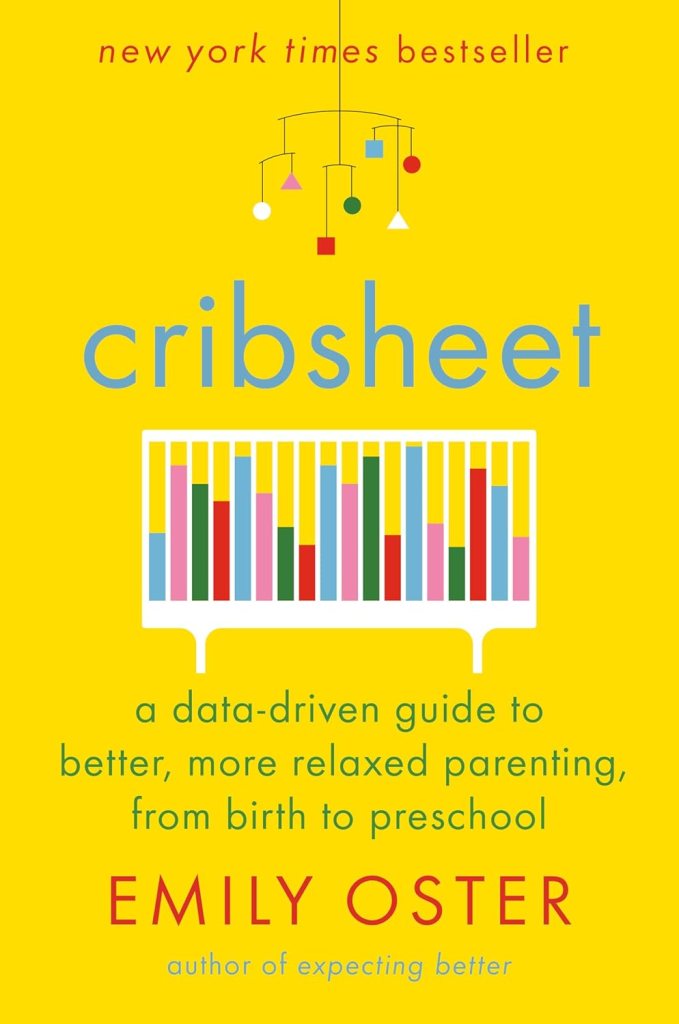
A Data-Driven Guide to Better, More Relaxed Parenting, from Birth to Preschool
Author: Emily Oster
I’m spending the bulk of 2024 pregnant. As a result, I am now knee-deep in pregnancy and child-rearing books.
I bought this book because it promised to be a fact-based approach to parenting, that I thought my computer nerd husband would appreciate. I was disappointed. Oster is clearly cherry-picking research to support how she chooses to raise her own kids. I’m sure she’s a fine mother, I was just hoping for a more unbiased approach.
Early in the book, Oster shares how she struggled with breastfeeding, So when she insisted that there is no benefit to breastfeeding I was floored. What?! excuse me WHAT?!
I’m not interested in “Mom Shaming” but I believe in being honest with ourselves. Breastmilk has been shown to contain antibodies (Johnson-Hence) and doctors have been encouraging mothers to breastfeed since the Middle Ages (Stevens) I’ve been doing lots of my own research about infant health, and I agree with what author Andrea Freeman had to say about this issue in her book Skimmed: formula is fast food for babies. It is food, and at the end of the day that’s what is important, feeding your kids fast food is not neglect or abuse, but it’s not ideal. There are health issues women can have that make breastfeeding a non-option, and I’m not interested in shaming anyone, but formula is not the same as breastmilk.
Oster even goes so far as to disregard attachment theory, pointing out that it has never been scientifically proven. That made me mad. Attachment theory (Fraley) is a scientific theory about how babies bond with their caregivers in correlation to the care they receive. Basically, it boils down to this: If parents don’t emotionally bond with their kids, the kids will struggle to form emotional bonds later in life. It’s not the kind of thing you CAN scientifically prove.
It’s not exactly ethical to ask people to be bad parents to definitively prove your child-rearing theories. Helmut Kentler actually did that, and he should have been shot! (Aviv)
I will be turning to other resources for parenting advice thank you.
Fraley, Chris. “A Brief Overview of Adult Attachment Theory and Research: R. Chris Fraley.” A Brief Overview of Adult Attachment Theory and Research | R. Chris Fraley, 2018, labs.psychology.illinois.edu/~rcfraley/attachment.htm.
Johnson-Hence, Chelseá B., et al. “Stability and Heterogeneity in the Antimicrobiota Reactivity of Human Milk-Derived Immunoglobulin a.” Journal of Experimental Medicine, The Rockefeller University Press, 7 Aug. 2023, rupress.org/jem/article/220/8/e20220839/214243/Stability-and-heterogeneity-in-the-antimicrobiota.
“I’m my mother’s first child, born when she was almost fourteen years old.”
Author: Carol Lynch Williams
Kyra Carlson has lived a very sheltered life. It’s just her, her mother, her father, his two other wives, and her twenty siblings… and the prophet.
When the prophet announces that Kyra will be the seventh wife of an old man. Kyra makes the decision to flee from the polygamist society she’s always known, but leaving isn’t going to be that easy.
My copy of the book contained an interview with Williams where she admitted that this book was based on stories of young people escaping from Fundamentalist Mormon Compounds.
I liked this book. I’m no expert on the FLDS but I know that I want Warren Jeffs’ cellmate to do to him what he did to those little girls. As far as I can tell, I think the story here is accurate to FLDS like cults at least in the 1990s.
The mobile library was striking to me. We don’t really have those here in New England and I don’t know why. Apparently, the rest of the country gets these cool buses driving around to parks and stuff bringing books and programs to the people; Meanwhile, in New England we sit in our Carnegie towers and cry that the children do not come.
“Real suffering isn’t just about physical pain, but about not knowing when the pain will end, not knowing what the point of it all is.”
Author: Kirstin Valdez Quade
The Padilla family is full of drama. Cancer, alcoholism, unemployment, neglectful parents, teen pregnancy, and that’s all under one roof! Once we get to the extended family there’s domestic abuse, sexual objectification of a child, and more!
This is a well-written drama about a messed-up family manipulating and enabling each other. It’s realistic and raw. All the characters make realistic mistakes and you understand why they make these bad decisions. If you read this book you will likely nod and say “I know these people.” If you are like me you will say “I know these people, and there is a reason I don’t talk to them anymore.”
My biggest weakness in the writing is that this novel grew out of a great short story. You can tell that the original short story was about the events of Holy Week. Amadeo Padilla (unemployed, neglectful father, and family alcoholic) is playing Jesus in the church passion play. Amadeo sees this as a way to get his life back on track, to finally make things right with God and his family. despite this, after the dramatic events during the play, he just goes back to his old ways. While it is realistic, I just wish this had more plot significance. don’t misunderstand me: It is realistic, lots of self-sabotaging people want to “pray away” their problems rather than make life changes to fix their problems. it is just a huge part of the plot that disappears.
My biggest criticism of the writing is that everything just works out for them because we as readers want a happy ending. While I have no problem believing that this family of enablers would lie to the cops to cover up for each other as they do in the book, that’s the problem, These people make horrible, dangerous, abusive choices and try to dodge the consequences of those decisions.
Angel is a very believable teen mom. Putting on an act of maturity she doesn’t really have. Again, very well written, I thought I could root for her. Early on I thought she wouldn’t mention the father because she was raped by her mom’s boyfriend, but no, it turns out she was just playing the “it’s not yours” mind games with him. You little b%$^%! In the end, Angel magically works everything out with her baby daddy… even though there is no mention of putting his name on the birth certificate so that his paternal rights and responsibilities are recognized by law. Yeah, that’s not going to end well.
Maybe I’m just cynical, but I have no hope that any of them will actually make their lives better. They are reactive instead of proactive.
This is not a criticism of the writing! This book was very well written. Some people- especially those who have been through generational trauma- are reactive instead of proactive in life.
I wasn’t kidding in my into, I’ve known people just like this! I have had to cut ties with friends and family who act like this because their toxic self-destructive behavior was dragging me into the same behavior. My favorite character was the sister, setting boundaries and calling toxic behavior.
If you are lucky enough to have lived a charmed life and have no idea what generational trauma can do to a family, check this book out.
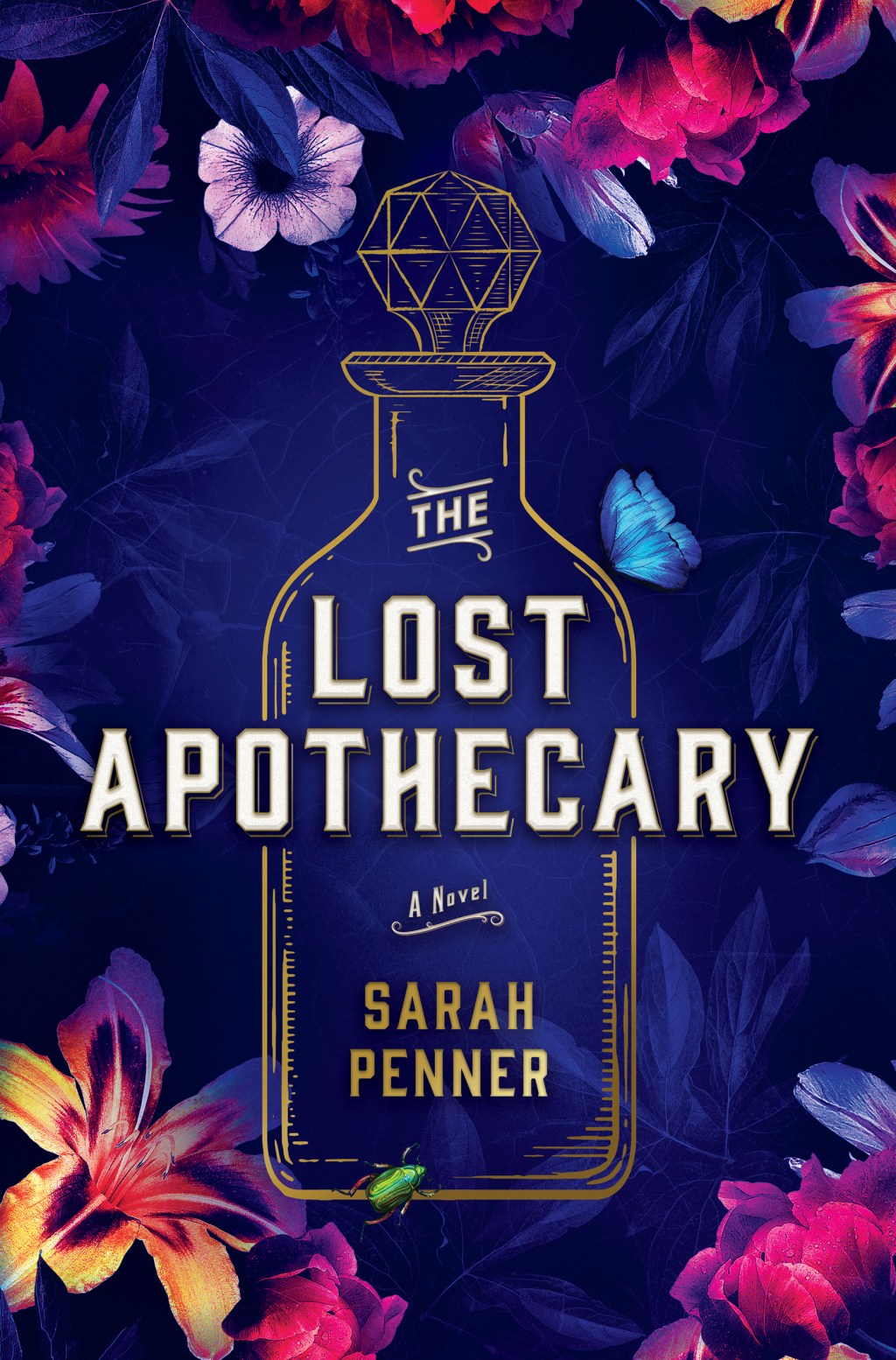
It’s okay to change… but it’s not okay to hide, to bury parts of ourselves
Author: Sarah Penner
In 6th-century London, a mild-mannered apothecary- Nella- gives out herbs and ointments to tend to the pains of local women… And if occasionally those pains come from a cheating husband, an unscrupulous employer, or a lusty landlord, well, there are herbs to deal with that too. Nella has two rules about her herbs: She will not poison a woman, and she must record everything in her book.
In modern-day London, Caroline is exploring the city, trying to forget her philandering husband and reconnect with her unused history degree. While exploring the riverbed, she finds an apothecary bottle, without a name etched on it. What kind of apothecary wouldn’t want people to know who made the treatment that helped someone? What is the story of this strange little bottle? Caroline becomes determined to tell the story of this strange little bottle, and the apothecary lost to time.
I want to like this book. I really do. Caroline’s husband is a great depiction of a controlling narcissist, but I’m glad the book doesn’t use that word because ultimately his diagnosis doesn’t matter, his behavior is unacceptable.
My big problem with books like this is that they tend to fall into the feminist territory of “women good, men bad” I understand why Nella doesn’t want her poisons used on women, but Nella is still providing means to kill people. I get that for her, it’s an ethical standard, but it really isn’t. Murder is not any more ethical just because of the victim’s reproductive organs. I just wish the book called that out more.
I also have an issue with the idea of Nella wanting to leave a record. I get it is so that Caroline can find her log book, but most non-nobles didn’t think about how they would be remembered. Willaim Shakespeare didn’t record an autobiography. I know that’s the theme of the book, but it’s a very 20th-century idea, and it bothered me.
If you believe the ladies in “Cell Block Tango” from Chicago that “they had it coming”, you will like this book.






 oddlibrarianout.com
You must be logged in to post a comment.