
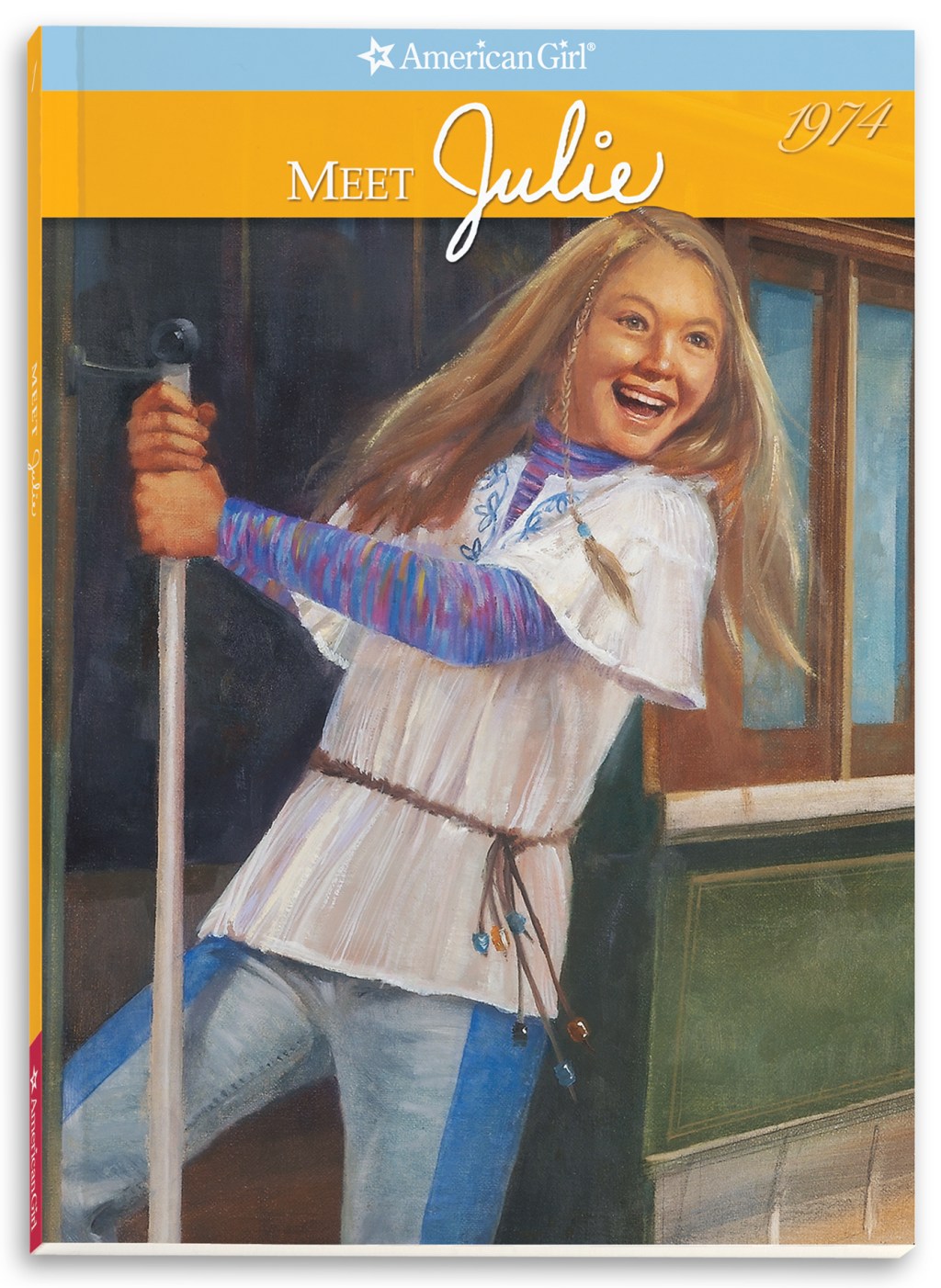

Author: Megan McDonald
It’s the 1970s. Bust out your mood rings and pet rocks!
The American Girl series is starting to feel more decades day at school and less about American history. Yes, it is important to remember that recent history is still history for kids, but it’s not like Julie’s mood ring is something kids would never see today. Heck, kids today still see fights about who gets to play on the gendered sports teams… it just looks different in 2025.
Julie’s personality
We are introduced to Julie as she is doing cartwheels. She is spinning, her life is turing upside-down. Like the other American Girl introductions this is Julie’s theme: Jukie is tumbling through the world looking for the right way up. Julie is struggling for identity. She doesn’t even know her favorite color!
Julie’s parent’s just got divorced, she’s moving and starting a new school, it’s the 1970s! Any of those alone can shake up your self-image, and Julie has to deal with all of it. She is very unsure of who she is and where she belongs in the world. Julie is also a Gen Xer, so not feeling like she belongs is to be expected.
Julie’s Family
Julie’s Mom is introduced to us taking down a hanging geranium plant. Geraniums symbolize folly. Is this telling us that the marriage was folly, or that Mom is a foolish person?
I like the representation of Julie’s parents. Something that bothers me in children’s media is when divorced parents are so united that you have to wonder why it didn’t work out… It’s very clear why Julie’s parents are divorced. Her dad is a straight laced kind of guy, her mom is a hippie. I get why it didn’t work out.
Basketball
So I did the math, Julie would have been born in 1965, and according to the generally accepted generation breakdowns, that is the very first birth year of Gen X. Like most Gen Xers, Julie is a latch-key kid. Julie takes up basketball as a way of avoiding the empty house. Julie’s fight to get on the basketball team feels very Gen X, she refuses to blindly trust authority figures, and she questions everything.
I think the school should have started a girl’s basketball team. Julie being the ONLY girl on the team is going to cause her social problems. She can’t bond with her teammates in the locker room, and she will be ostracised by the other girls. The other girls will be jealous that Julie found a way to stand out, and being yourself and standing out is not how you make friends as a pubescent girl. Yeah, girls are like that.
Best Friends
Speaking of girls why did Ivy apologize? She just didn’t want to spend her whole Saturday getting signatures for Julie’s petition. Julie never asked Ivy to help her, she just blindly assumed Ivy would. Poor Ivy was dragged around the streets of San Francisco, and her best friend Julie was completely clueless about Ivy’s obvious discomfort… I seriously want to know why Ivy owes Julie an apology.
All in all Julie is a fun character, but you can start to see the cracks in the original American Girl concept starting to form: it’s not like Julie is wearing a shift and stays, she wears blue jeans and tanktops, the cut and colors might be different, but kids still see those cloths today. Julie’s world just isn’t so different from the world today that tactile play (dolls) will help kids understand it.

 oddlibrarianout.com
You must be logged in to post a comment.