Tag: Feminist Literature

  • Meet Julie

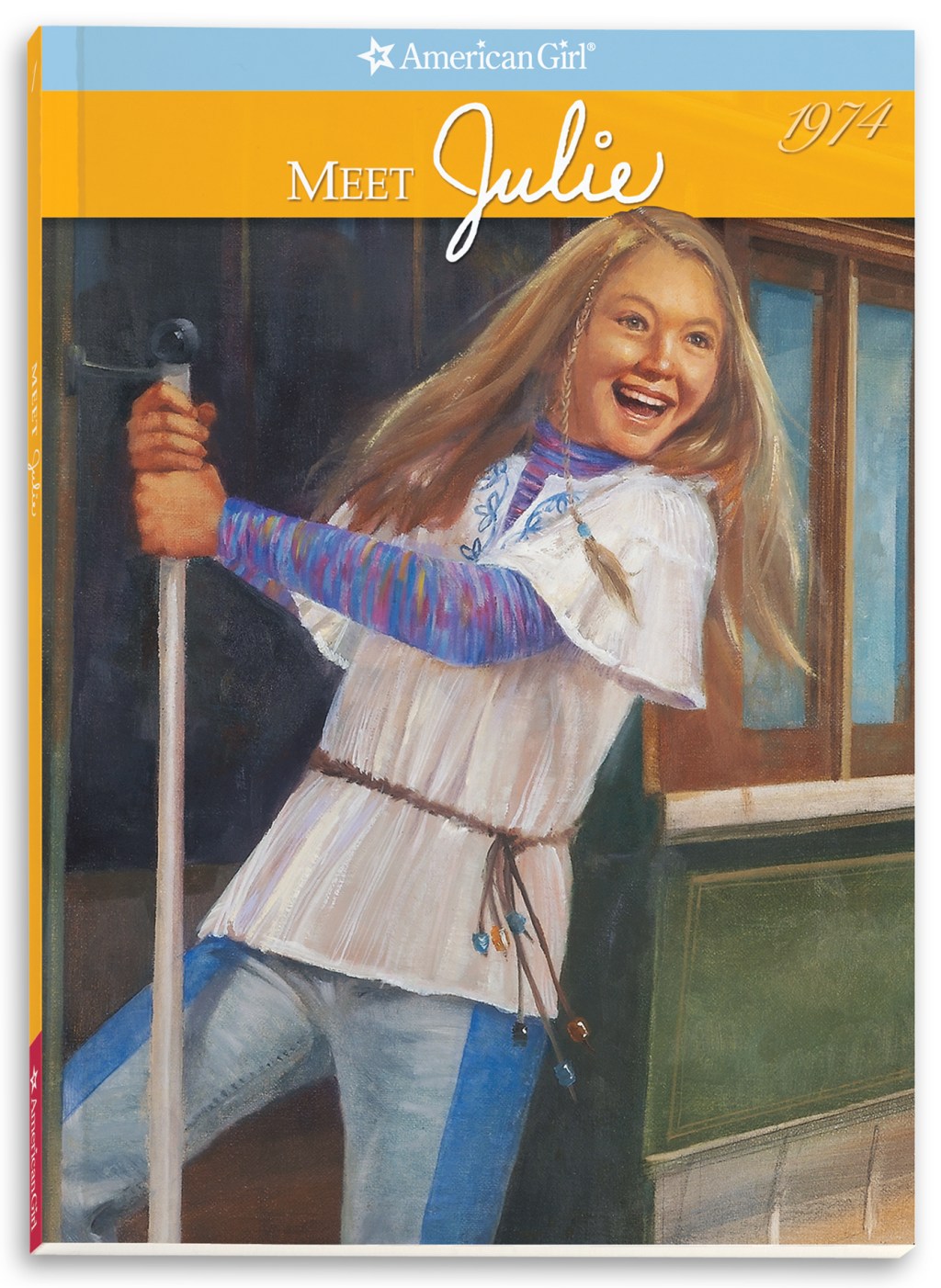
    Meet Julie

    No turning back now

    Author: Megan McDonald

    It’s the 1970s. Bust out your mood rings and pet rocks!

    The American Girl series is starting to feel more decades day at school and less about American history. Yes, it is important to remember that recent history is still history for kids, but it’s not like Julie’s mood ring is something kids would never see today. Heck, kids today still see fights about who gets to play on the gendered sports teams… it just looks different in 2025.

    Julie’s personality

    We are introduced to Julie as she is doing cartwheels. She is spinning, her life is turing upside-down. Like the other American Girl introductions this is Julie’s theme: Jukie is tumbling through the world looking for the right way up. Julie is struggling for identity. She doesn’t even know her favorite color!

    Julie’s parent’s just got divorced, she’s moving and starting a new school, it’s the 1970s! Any of those alone can shake up your self-image, and Julie has to deal with all of it. She is very unsure of who she is and where she belongs in the world. Julie is also a Gen Xer, so not feeling like she belongs is to be expected.

    Julie’s Family

    Julie’s Mom is introduced to us taking down a hanging geranium plant. Geraniums symbolize folly. Is this telling us that the marriage was folly, or that Mom is a foolish person?

    I like the representation of Julie’s parents. Something that bothers me in children’s media is when divorced parents are so united that you have to wonder why it didn’t work out… It’s very clear why Julie’s parents are divorced. Her dad is a straight laced kind of guy, her mom is a hippie. I get why it didn’t work out.

    Basketball

    So I did the math, Julie would have been born in 1965, and according to the generally accepted generation breakdowns, that is the very first birth year of Gen X. Like most Gen Xers, Julie is a latch-key kid. Julie takes up basketball as a way of avoiding the empty house. Julie’s fight to get on the basketball team feels very Gen X, she refuses to blindly trust authority figures, and she questions everything.

    I think the school should have started a girl’s basketball team. Julie being the ONLY girl on the team is going to cause her social problems. She can’t bond with her teammates in the locker room, and she will be ostracised by the other girls. The other girls will be jealous that Julie found a way to stand out, and being yourself and standing out is not how you make friends as a pubescent girl. Yeah, girls are like that.

    Best Friends

    Speaking of girls why did Ivy apologize? She just didn’t want to spend her whole Saturday getting signatures for Julie’s petition. Julie never asked Ivy to help her, she just blindly assumed Ivy would. Poor Ivy was dragged around the streets of San Francisco, and her best friend Julie was completely clueless about Ivy’s obvious discomfort… I seriously want to know why Ivy owes Julie an apology.

    All in all Julie is a fun character, but you can start to see the cracks in the original American Girl concept starting to form: it’s not like Julie is wearing a shift and stays, she wears blue jeans and tanktops, the cut and colors might be different, but kids still see those cloths today. Julie’s world just isn’t so different from the world today that tactile play (dolls) will help kids understand it.
  • Spoiler-Free Review: Where The Crawdads Sing

    Spoiler-Free Review: Where The Crawdads Sing

    “Just like their whiskey, the marsh dwellers bootlegged their own laws”

    Author: Delia Owens

    Chase Andrews fell from the old fire tower… or was he pushed? As the sheriff investigates the strange death, he discovers a connection between the local girl “Marsh Girl” and Chase. No one knows the marsh better than Kya, the “Marsh Girl,” but does she know it well enough to kill a man without leaving a trace? Will Kya be locked up for murder? or will she stay in the marsh she loves, free and wild, where the crawdads sing?

    Kya is a very nice change of pace from the super competent female protagonist of many novels you get these days. Kya is a character living with trauma. She both craves and fears human connection. She wants to love and be loved, but her life experience has taught her that other people will only hurt and abandon her.

    Kya’s was abused/neglected/ abandoned by her whole family. Pa was abusive, Ma walked out, and her older siblings ran away from home. While Pa was good to Kya sometimes, he never cared enough to take her to school, buy her shoes, or teach her to read. Then one day, he went out drinking and never came home.

    Kya is a lot like a wild animal, acting on instinct and withdrawing in fear. It’s exactly what a child who raised themselves would be like.

    The murder mystery was the weakest part for me. I knew the truth of how Chase died VERY early on in the story. I don’t think the murder mystery was intended to be the point. It’s Kya’s story, and the mystery was a narrative device to drive the plot forward.

    There is a reason this book was so popular and it was quickly turned into a movie. Owens knocked it out of the park with her first novel! It is well worth the read.

  • Spoiler-Free Review: The Lost Apothecary

    Spoiler-Free Review: The Lost Apothecary

    It’s okay to change… but it’s not okay to hide, to bury parts of ourselves

    Author: Sarah Penner

    In 6th-century London, a mild-mannered apothecary- Nella- gives out herbs and ointments to tend to the pains of local women… And if occasionally those pains come from a cheating husband, an unscrupulous employer, or a lusty landlord, well, there are herbs to deal with that too. Nella has two rules about her herbs: She will not poison a woman, and she must record everything in her book.

    In modern-day London, Caroline is exploring the city, trying to forget her philandering husband and reconnect with her unused history degree. While exploring the riverbed, she finds an apothecary bottle, without a name etched on it. What kind of apothecary wouldn’t want people to know who made the treatment that helped someone? What is the story of this strange little bottle? Caroline becomes determined to tell the story of this strange little bottle, and the apothecary lost to time.

    I want to like this book. I really do. Caroline’s husband is a great depiction of a controlling narcissist, but I’m glad the book doesn’t use that word because ultimately his diagnosis doesn’t matter, his behavior is unacceptable.

    My big problem with books like this is that they tend to fall into the feminist territory of “women good, men bad” I understand why Nella doesn’t want her poisons used on women, but Nella is still providing means to kill people. I get that for her, it’s an ethical standard, but it really isn’t. Murder is not any more ethical just because of the victim’s reproductive organs. I just wish the book called that out more.

    I also have an issue with the idea of Nella wanting to leave a record. I get it is so that Caroline can find her log book, but most non-nobles didn’t think about how they would be remembered. Willaim Shakespeare didn’t record an autobiography. I know that’s the theme of the book, but it’s a very 20th-century idea, and it bothered me.

    If you believe the ladies in “Cell Block Tango” from Chicago that “they had it coming”, you will like this book.